
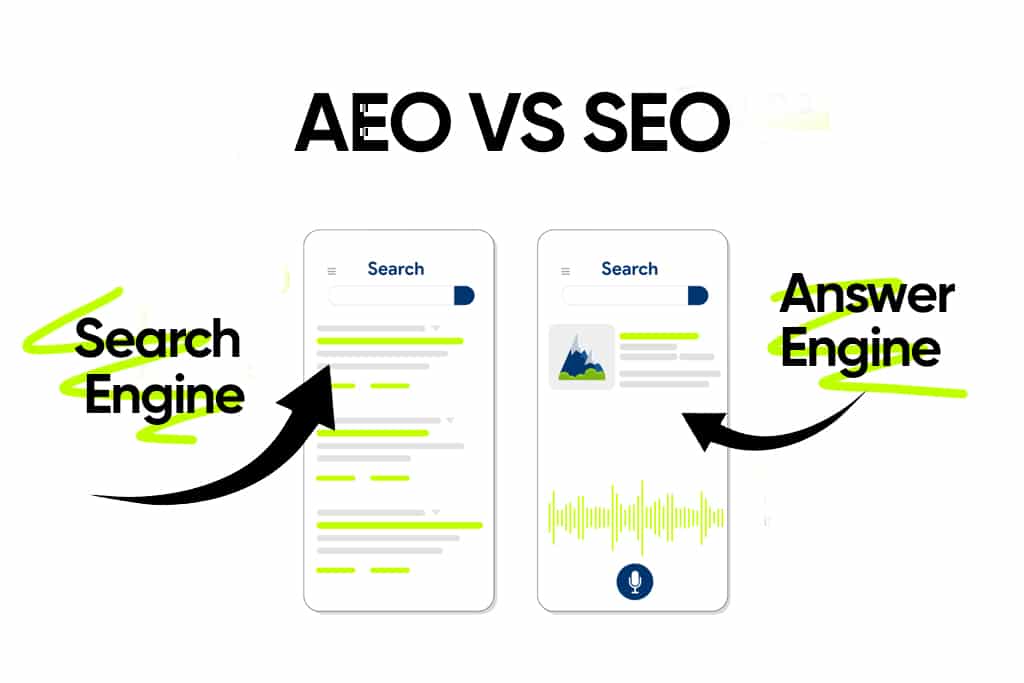
Answer Engine Optimization (AEO) is the practice of structuring your website content so that AI-powered search engines (Google AI Overviews, ChatGPT, and Perplexity) select you as a cited source when users ask questions related to your business. The goal isn’t a position on a search results page. The goal is to be the answer.
Most business owners haven’t heard of AEO yet. That’s a window of opportunity. The businesses that adapt their content now, before their competitors catch on will hold an advantage that compounds as AI search becomes the default way people find products, services, and local recommendations.
Why AI Search Is Changing the Way Customers Find You
The way people search online has shifted faster than most businesses have adapted. In 2026, Google AI Overviews appear in roughly 30% of all searches, and up to 74% of problem-solving queries. ChatGPT surpassed 800 million weekly active users by late 2025, with a growing share of those conversations replacing what used to be standard Google searches.
The shift changes the customer journey in a fundamental way. Instead of clicking through a list of links, users read an AI-generated summary that pulls from multiple sources across the web. Your content is being evaluated, extracted, and synthesized, often without the user ever clicking through to your site. Search rankings alone no longer determine whether people find your business.
This is the environment AEO is built for. While traditional SEO helps your pages rank, AEO determines whether your content is the source an AI engine cites when someone asks a question your business could answer.
What AEO Actually Means for Your Business
AEO isn’t a new algorithm to chase or a marketing trend to wait out. It’s a practical question: when someone asks an AI engine a question that your business could answer, does your content get cited?
Consider a practical example. A traveler asks ChatGPT: ‘What is the best surf school in Canggu for beginners?’ ChatGPT doesn’t return a list of links. It gives a direct answer, a recommendation with context. The surf schools that appear in that answer are there because their content is structured in a way AI can extract, understand, and trust.
That’s AEO working as intended. It isn’t about gaming a system. It’s about writing clearly, structuring content deliberately, and making sure your expertise is legible to both human readers and AI engines reading your pages.

How AEO Differs From Traditional SEO
SEO and AEO share the same foundation, quality content, technical site health, and credibility signals. But the goal each discipline optimizes for is different, and so are the specific tactics that matter most.
SEO optimizes for ranking signals: backlinks, keyword density, domain authority, page speed, and crawlability. These signals tell Google’s traditional algorithm which pages deserve the top positions in search results.
AEO optimizes for answer signals: directness, structured content formats such as FAQ sections and definition blocks, E-E-A-T (Experience, Expertise, Authority, Trust), and schema markup. These signals tell AI engines which sources deserve to be cited.
A site that ranks number one on Google might never be cited by an AI engine if the content isn’t structured for extraction. A smaller site with well-structured, genuinely expert content can get cited consistently, and that asymmetry is what makes AEO especially valuable for businesses that have struggled to compete on pure SEO budget.
What AI Engines Look For When Choosing Sources
Understanding what makes AI engines select a source takes most of the mystery out of AEO. At a basic level, three signals matter most.
Directness: AI engines prioritize content that answers the question within the first 100 words. A page that spends five paragraphs on context before reaching the point gets skipped. Leading with the answer, not the preamble, is the most important habit in AEO writing.
Structured formatting: FAQ sections with proper heading tags, numbered steps, definition paragraphs, and clear bullet lists are formats AI engines consume predictably. Dense, unformatted prose is harder to extract and less likely to be cited as a source.
Trustworthiness (E-E-A-T): Experience, Expertise, Authority, and Trust, the quality framework Google uses for content evaluation, also influences AI source selection. Content that demonstrates real expertise through specific examples, first-hand knowledge, and accurate data is consistently weighted above generic writing.
Why Acting Now Gives You a Real Advantage
AEO is still in its early adoption phase. Most businesses, including most of your competitors, haven’t yet adapted their content for AI search. That creates an opportunity that won’t stay open forever.
When Google rolled out AI Overviews broadly in 2024, most business owners didn’t change anything about their content. The businesses that did, by adding direct answer paragraphs, FAQ sections, and definition blocks, started appearing in AI-generated answers without spending more on advertising or link building.
The window isn’t permanent. As more businesses adopt AEO practices, AI engines will have more sources to choose from. Early movers who establish themselves as reliable cited sources build an advantage that compounds, because AI engines learn from content they have already cited, making established sources more likely to remain cited over time. Gartner projected a 25% drop in traditional search volume by 2026 due to AI chatbots, and that projection is arriving on schedule.
Where to Start If You Are New to AEO
The starting point for AEO is simpler than most people expect. Four changes cover the foundational work, and none of them require rebuilding your website from scratch.
1. Write a direct answer at the top of each key page. For every important question a potential customer might ask about your product or service, write a 40-60 word answer and place it near the top of the relevant page. This is the format AI engines extract most reliably.
2. Add an FAQ section to your main service pages. Use a proper heading tag (H3) for each question and write 2-4 sentence answers. This single structural change has the highest AEO impact for most sites, because FAQ content matches the question-and-answer format AI engines prefer.
3. Write from genuine expertise. Reference specific outcomes, mention real locations and client situations, and avoid generic language. AI engines have become effective at detecting content written by someone who actually knows the subject.
4. Clean up your internal links. AI engines follow how pages on your site connect to each other. A well-linked site signals that your content forms a coherent body of knowledge, not a collection of isolated pages optimized for individual keywords.

What AEO Results Actually Look Like
AEO results look different from what standard SEO dashboards show. You aren’t tracking rank positions, you’re tracking citation frequency and the signals that lead to it.
When AEO is working, your business or brand name appears in AI-generated answers when someone asks a relevant question. Your content gets cited as a source in Google AI Overviews for queries in your industry. You start receiving organic referral traffic from Perplexity and other AI platforms. Branded search volume increases as people who encountered your name in an AI answer then search for you directly.
These are real results, accessible to businesses of any size. AEO rewards content quality and structure over budget and domain authority. A small business with well-structured, genuinely expert content can appear in AI answers ahead of larger competitors with bloated, generic websites. That’s the fundamental shift AEO represents, and it is why getting started now is worth the effort.
Ready to Find Out Where Your Business Stands in AI Search?
AEO is still early enough that getting started now gives you a real head start over competitors. We help businesses in BSD, Tangerang, and Bali build their presence in AI search, starting with a structured audit of what is already there.